
Key takeaways
- PRP is technique sensitive, and accuracy matters. Ultrasound guidance helps place PRP in the exact tissue that needs support instead of relying on estimates.
- Ultrasound provides real time confirmation. It allows the clinician to visualize the target, track the needle, and avoid nearby sensitive structures for more precise delivery.
- The benefits are biggest for tendons and complex areas. Conditions like tennis elbow, Achilles tendinopathy, rotator cuff issues, and deeper joints often require a very specific target zone.
- PRP works best with a plan, not as a standalone fix. Pairing ultrasound guided PRP with the right rehab and progressive loading strategy supports stronger, longer lasting results.
Avid Sports Medicine combines sports medicine expertise with individualized physical therapy, performance based strength programming, and ultrasound guided regenerative procedures to help people recover, move better, and stay active. Our team takes a diagnosis first approach, then builds a clear plan that supports healing and long term results. If you are dealing with stubborn tendon pain, joint irritation, or an injury that keeps returning, we can help you explore options like ultrasound guided PRP and other regenerative treatments when appropriate, along with the rehab support that helps your results last.
PRP has become one of the most talked about regenerative treatments in sports medicine, and for good reason. When it is used thoughtfully, PRP can support healing in tendons, ligaments, and joints by delivering a concentrated dose of your body’s own platelets to the area that needs help. For many active people, it can be a meaningful option when pain has lingered, progress has stalled, or you want to avoid more invasive interventions.
At the same time, PRP is not a one size fits all solution. It is a technique sensitive treatment. The right diagnosis matters. The right type of PRP matters. And just as importantly, the right placement matters.
This is where ultrasound guidance comes in.
If you have ever wondered why one person raves about PRP while another feels like it “didn’t do much,” there are often multiple factors. The condition may not have been the best match. The rehab plan may not have supported the biology of healing. But one of the most overlooked variables is accuracy. PRP needs to be delivered to the right tissue, at the right depth, in the right area of the problem.
Ultrasound guidance helps make that possible. It gives the clinician a live view of the tissue and the needle so the treatment can be placed with intention, not guesswork. For people who want the best possible chance of a strong response, that precision matters.
What PRP Therapy Is And What It Is Designed To Do
PRP stands for platelet rich plasma. Platelets are a part of your blood that contain growth factors and signaling proteins that help coordinate healing. In a PRP procedure, a small amount of your blood is drawn and processed to concentrate platelets. That platelet rich portion is then injected back into a specific area, such as a tendon, a ligament, or a joint.
PRP is often used for conditions like:
- Tendinopathies, such as tennis elbow or Achilles tendon pain
- Partial tendon injuries
- Certain ligament sprains or chronic irritation
- Mild to moderate joint arthritis
- Some overuse injuries where tissues struggle to calm down and remodel
PRP is not a pain numbing injection. It is a treatment intended to support tissue repair and remodeling. That is why the placement and the follow up plan matter so much. You are not just trying to feel better for a few days. You are trying to create a better healing environment over weeks and months.
Why Accuracy Matters In Regenerative Medicine
When people think about accuracy, they often imagine the needle “getting to the general area.” But PRP works best when it is delivered to the exact tissue that is driving symptoms.
This is important because many musculoskeletal problems are not simple. Pain around a joint might be coming from a tendon attachment. A “knee pain” complaint might be patellar tendon irritation, a fat pad issue, early cartilage changes, or a combination. Even within a single tendon, there may be a specific portion that is thickened, irritated, or partially torn, while adjacent areas look relatively healthy.
In other words, the target matters.
When PRP is placed too far from the tissue that needs it most, the treatment may not have the same opportunity to do its job. It is like watering the soil next to the plant instead of watering the roots. It might still help a little, but it is not the same as getting it where it needs to go.
Accuracy also matters for safety and comfort. Ultrasound helps clinicians avoid sensitive structures and reduce unnecessary trauma to surrounding tissue. That can mean a smoother experience and a clearer path into the exact treatment zone.
What Ultrasound Guidance Actually Is
Ultrasound is a real time imaging tool that uses sound waves to visualize structures inside the body. In sports medicine, ultrasound is commonly used to assess tendons, ligaments, muscles, bursae, and certain joint structures. It can also be used dynamically, meaning the clinician can watch tissue move while you move.
For injections, ultrasound becomes a guidance tool. The clinician can see the target tissue and can also see the needle as it advances toward the target. This allows the injection to be placed with precision, rather than relying on surface anatomy alone.
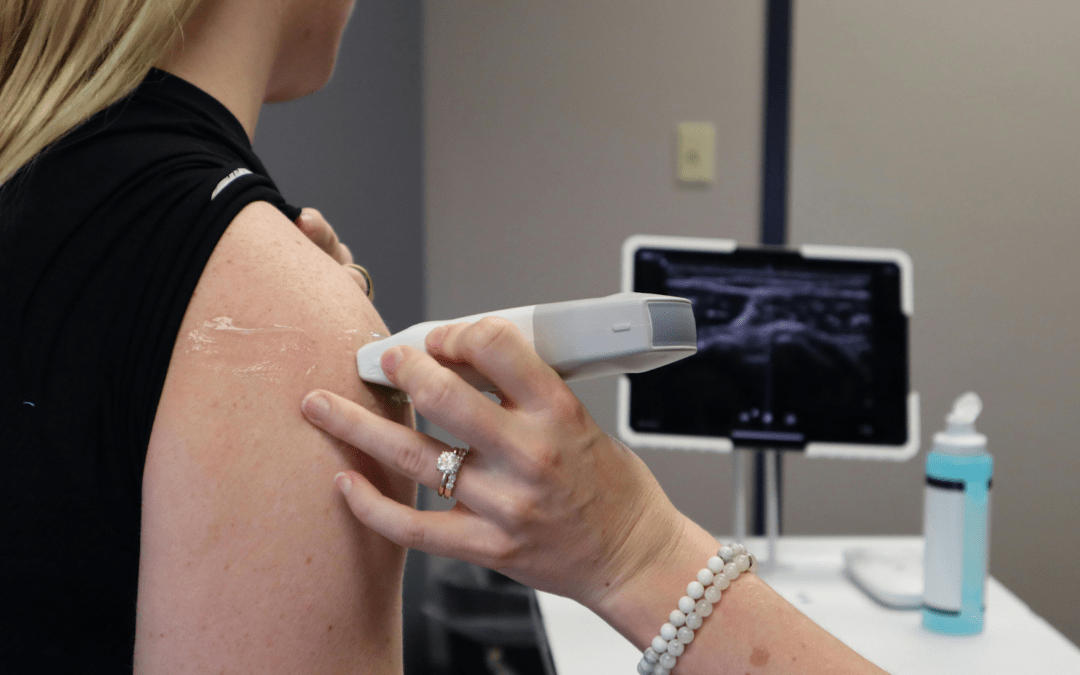
Some people worry that ultrasound sounds intimidating. In practice, it is typically simple and efficient. A probe with gel is placed on the skin. The image appears on a screen. Then the injection is performed while the clinician watches the needle placement live.
Ultrasound Guidance Vs Landmark Guidance: What Is The Difference?
Landmark guidance is when an injection is placed based on palpation and anatomical landmarks. For certain straightforward joint injections, experienced clinicians may achieve good results with landmarks alone. However, accuracy can vary based on the joint, the person’s anatomy, and the exact target.
Ultrasound guidance adds visual confirmation.
Instead of estimating where the tendon insertion begins, you can see it. Instead of aiming for a bursa based on feel, you can confirm you are in the right space. Instead of hoping the needle is within a small target zone, you can watch it arrive there.
That difference becomes more important as targets become smaller or more complex. Tendons, tendon insertions, and partial tears often require more precision than a broad joint space. In those cases, ultrasound guidance can be a major advantage.
The Biggest Ways Ultrasound Improves Prp Accuracy
Ultrasound guidance is not just a “nice add on.” It changes how precisely PRP can be delivered. Here are the main benefits, explained in a practical way.
It helps confirm the true target tissue
Pain location is not always the same as the source. Ultrasound can help identify tissue changes like thickening, degeneration, swelling, or partial tearing. That helps confirm that PRP is being used for the right reason, and it helps refine the target zone.
This matters because PRP outcomes improve when treatment is matched to diagnosis. If the diagnosis is off, even a perfectly placed injection may not deliver the result you want.
It allows precise placement within a tendon or insertion
Tendons are not uniform. A tendon can have a small area that is most irritated or degenerated. Ultrasound helps identify that area and allows the clinician to place PRP exactly there.
This can be especially helpful for common problem areas like:
- Tennis elbow at the common extensor tendon
- Jumper’s knee at the patellar tendon
- Achilles insertion or mid portion tendinopathy
- Rotator cuff tendinopathy or partial tears
- Gluteal tendon irritation at the hip
These are often not “one spot” problems. Ultrasound guidance helps make the treatment more targeted.
It helps avoid nearby sensitive structures
Around tendons and joints, there can be nerves, blood vessels, and other structures you do not want to irritate. Ultrasound helps the clinician plan a path that avoids those structures. This improves safety and can reduce post injection flare that comes from unnecessary irritation in the wrong area.
It improves consistency
One of the reasons PRP results can feel inconsistent across different clinics is that technique varies. Ultrasound guidance supports a more repeatable process. It helps reduce variability related to anatomy differences, body size, and subtle variations in landmarks.
In many cases, consistency is what turns a good idea into a reliable outcome.
Why Ultrasound Guidance Matters Even More For Certain Body Areas
Not every injection target is the same. Some structures are easier to access than others. Ultrasound guidance becomes especially valuable when targets are smaller, deeper, or harder to locate reliably.
Examples include:
- Hip joint injections, which are deeper and have important structures nearby
- Certain shoulder injections where multiple tendons and bursae are close together
- Small tendon insertions where the target zone is very specific
- Cases where anatomy is unique, such as prior injuries, surgery, or significant swelling
In these situations, ultrasound guidance can be the difference between “close enough” and “exactly where we intended.”
What The Prp Experience With Ultrasound Typically Looks Like
Many people feel nervous before their first PRP procedure because they do not know what to expect. Here is a clear overview of what a typical ultrasound guided PRP visit may include.
Step 1: Evaluation and planning
A good PRP plan starts with a proper diagnosis. That includes a clinical exam and may include ultrasound imaging to confirm tissue changes. The goal is to ensure PRP is being used for a condition where it makes sense, and that the target zone is clearly identified.
Step 2: Blood draw and PRP preparation
A small amount of blood is drawn, similar to a routine lab draw. That blood is processed to concentrate platelets. Different systems and techniques can produce different concentrations and compositions. This is one reason it matters where you receive PRP.
Step 3: Ultrasound guided injection
The skin is cleaned. Ultrasound gel is applied. The clinician uses the ultrasound image to guide the needle precisely to the target tissue. You may feel pressure, and sometimes a brief increase in discomfort when the treatment is delivered into the irritated tissue, especially with tendons.
Step 4: Aftercare and rehab plan
PRP is not a “do the injection and hope” treatment. The plan after the procedure is part of the treatment. You may be advised to adjust activity temporarily, then progress back into strengthening and loading over time.
That progression supports the biology of healing.
Recovery And Expectations: What Is Normal After Prp?
PRP can create a temporary increase in soreness because it is designed to stimulate a healing response. Many people feel more discomfort for a few days, sometimes up to a week or two, depending on the target and the condition.
It is also common for improvement to be gradual. Some people notice early changes in pain, but many notice the bigger shift over several weeks as the tissue begins to remodel. This is why the right rehab plan matters. Tendons and ligaments respond to progressive loading. PRP can support healing, and rehab teaches the tissue to become resilient again.
A helpful way to think about PRP is that it can help restart the healing conversation in a tissue that has been stuck. Then the movement plan helps translate that healing into function.
The Role Of Rehab: Why Prp Works Best With The Right Plan
One of the biggest mistakes people make is treating PRP like a stand alone solution. In reality, PRP is often the beginning of a phase, not the end.
If a tendon has been irritated for months, it usually needs a smarter loading plan. That might include:
- Progressive strengthening that respects pain thresholds
- Stability work to reduce strain on the injured tissue
- Mobility work to improve movement mechanics
- Gradual return to sport specific drills
When PRP is paired with a structured plan, the results tend to feel more durable. You are not just calming symptoms. You are building capacity so the injury does not keep coming back.
Who May Benefit Most From Ultrasound Guided Prp?
Ultrasound guided PRP is often a strong fit for people who have:
- Chronic tendon pain that has not improved with rest alone
- Tendinopathy confirmed by clinical exam and imaging
- Mild to moderate arthritis where reducing pain and improving function is the goal
- Partial tendon injuries where supporting healing makes sense
- A desire to return to sport or activity with a plan designed for long term outcomes
It is also helpful for people who have tried generic approaches and feel like they keep cycling back into pain. Precision in diagnosis and precision in treatment can change the trajectory.
Choosing The Right Clinic For Prp
PRP is not just about having access to equipment. It is about the process.
When evaluating a provider, it helps to ask:
- Do they use ultrasound guidance?
- Do they assess the tissue and confirm the diagnosis before injecting?
- Do they customize the PRP approach to the condition?
- Do they provide a clear rehab and return to activity plan?
- Do they understand the demands of your sport or daily life?
- You want a team that treats PRP as part of a bigger strategy, not as a standalone product.
Ultrasound Guided PRP At Avid Sports Medicine
If you are considering PRP, accuracy is one of the most important factors you can control. Ultrasound guidance helps deliver PRP precisely to the tissue that needs support, which can improve consistency and confidence in your treatment plan. At Avid Sports Medicine in San Francisco, our team combines detailed evaluation, ultrasound guided procedures, and individualized rehab planning to support healing and long term performance. Whether you are dealing with stubborn tendon pain, joint irritation, or an overuse injury that keeps coming back, we help you understand your options and build a plan that matches your goals.
Ready to take the next step? Schedule an appointment with Avid Sports Medicine today to find out if ultrasound guided PRP is the right fit for your recovery and your return to activity.