
Key Takeaways
- Some scar tissue after knee replacement is normal, but excessive fibrous tissue can develop into arthrofibrosis and restrict movement.
- Persistent loss of knee flexion or extension should be evaluated because postoperative stiffness can have several causes besides scar tissue.
- Physical therapy plays an important role in restoring motion, controlling swelling, rebuilding strength, improving gait, and identifying when recovery has stalled.
- Avid Sports Medicine can support knee replacement rehabilitation with individualized physical therapy, movement assessment, gait retraining, and progressive strength work while coordinating with surgical care when additional intervention is needed.
Some stiffness after knee replacement is expected. The knee has been through a major procedure, tissues need time to heal, swelling can limit movement, and the muscles surrounding the joint may initially feel weak or reluctant to work normally.
For most patients, mobility gradually improves as swelling settles and rehabilitation progresses. Bending becomes easier, walking becomes more natural, and the knee begins to feel less protective with everyday movement.
Sometimes, however, stiffness does not follow that expected pattern. Instead of steadily gaining movement, the knee may remain difficult to bend or straighten. It may feel unusually tight, restricted, or painful despite consistent recovery efforts. When excessive scar tissue develops around the joint and begins to limit motion, the condition may be referred to as arthrofibrosis.
Scar tissue after knee replacement is therefore not automatically a problem. Scar formation is part of normal healing. The concern is when that healing response becomes excessive enough to interfere with range of motion and daily function.
Understanding the difference can help patients know when they simply need more recovery time and when persistent stiffness deserves a closer evaluation.
Why Scar Tissue Forms After Knee Replacement
Scar tissue is a normal part of the body’s healing process.
When tissues are disrupted during surgery, the body begins repairing the area by producing collagen and other structural materials. This creates scar tissue that helps stabilize and heal the surgical site.
Inside the knee, some of that response occurs around the joint capsule and other tissues that were affected during surgery. In most people, healing progresses while movement gradually returns.
Arthrofibrosis develops when this repair response becomes excessive. Too much fibrous tissue can form within and around the joint, and the capsule surrounding the knee may begin to tighten. Instead of helping recovery, the scar tissue starts restricting normal movement.
Recent research increasingly describes arthrofibrosis as a biological healing disorder rather than simply a mechanical problem. Inflammatory signaling, individual healing responses, and other factors may influence why some patients develop substantial stiffness while others do not.
This also explains why two people can undergo similar knee replacement procedures and experience very different recovery patterns.
Normal Stiffness And Problematic Scar Tissue Are Different
Early after knee replacement, the knee commonly feels swollen, tight, and difficult to move. These symptoms alone do not mean someone has developed excessive scar tissue.
The important factor is progression.
A recovering knee should generally become easier to move over time, even if improvement happens gradually. A patient may have good days and difficult days, particularly after increasing activity, but the overall trend should be toward better mobility and function.
Excessive scar tissue becomes more concerning when progress stalls for an extended period or range of motion begins to remain significantly restricted.
A patient may notice that bending has reached the same point week after week, straightening the leg remains difficult, or activities that require knee motion are not becoming easier despite rehabilitation.
The pattern matters more than one stiff morning.
What Does Scar Tissue After Knee Replacement Feel Like?
Patients with problematic scar tissue often describe the knee as feeling mechanically restricted rather than simply sore.
The joint may feel as though something is physically stopping it from bending farther. Others describe persistent tightness around the front or sides of the knee, pressure inside the joint, or difficulty fully straightening the leg.
As the restriction becomes more noticeable, everyday activities may become harder. Getting out of a chair can require extra effort, stairs may feel awkward, and getting into a car may become frustrating because the knee does not bend enough.
Walking can change too. If the knee cannot fully straighten, a patient may walk with the leg slightly bent. If bending is limited, the person may compensate by swinging the leg or changing hip movement.
These compensations can eventually contribute to discomfort elsewhere.
Range Of Motion Gives Important Clues
Range of motion is one of the most closely watched parts of knee replacement rehabilitation.
Knee flexion refers to bending, while extension refers to straightening. Both are important for normal function.
Straightening is particularly important for comfortable standing and walking. Bending is necessary for sitting, stairs, getting in and out of vehicles, cycling, and many recreational activities.
There is no single perfect number every patient must achieve on exactly the same timeline. Recovery varies based on pre-surgical mobility, the type of procedure, swelling, strength, pain, medical history, and individual healing.
However, persistent limitations should not simply be ignored.
Recent clinical literature describes arthrofibrosis as persistent restriction in knee movement after other causes of stiffness have been excluded. The important point for patients is not memorizing a specific degree measurement, but noticing whether movement is continuing to improve.
Why Early Motion Matters
Movement after knee replacement has several purposes.
It helps restore range of motion, prevents the knee from remaining in one protected position for too long, improves circulation, and allows the muscles around the joint to begin functioning normally again.
This does not mean patients should aggressively force the knee through severe pain.
More is not always better.
Overly aggressive exercise can increase swelling and irritation, which may make movement more difficult. The goal is consistent, appropriately dosed mobility work that allows the knee to progress without repeatedly triggering major flare-ups.
A physical therapist can help find that balance.
In the early stages of recovery, small improvements made consistently often matter more than trying to force dramatic changes during one treatment session.
Swelling Can Look Like Scar Tissue
One reason knee stiffness can be confusing is that swelling itself can dramatically limit movement.
A swollen knee may feel tight, heavy, and difficult to bend. The quadriceps may also become harder to activate when significant swelling is present, which can make walking and exercise more difficult.
A patient may assume scar tissue is blocking the knee when inflammation is playing a large role.
This is why persistent stiffness should be evaluated rather than self-diagnosed.
The clinician needs to consider swelling, muscle guarding, pain, joint mechanics, scar formation, and other possible reasons for limited motion.
Treating the wrong cause can waste valuable recovery time.
Why The Quadriceps Matter So Much
Knee replacement rehabilitation is not only about bending the joint.
The quadriceps play an enormous role in restoring function.
After surgery, swelling and pain can temporarily reduce the nervous system’s ability to activate the quadriceps normally. The muscle may feel weak even if it was relatively strong before surgery.
That weakness affects walking, standing from a chair, climbing stairs, and controlling the knee during daily activity.
When the knee remains stiff, quad weakness can become even more pronounced because the patient naturally begins using the leg less.
Rehabilitation therefore needs to address both motion and strength.
Improving range of motion without rebuilding the muscles around the knee leaves recovery incomplete.
The Incision Scar Is Not The Same As Arthrofibrosis
Patients sometimes use the term "scar tissue" to describe several different things.
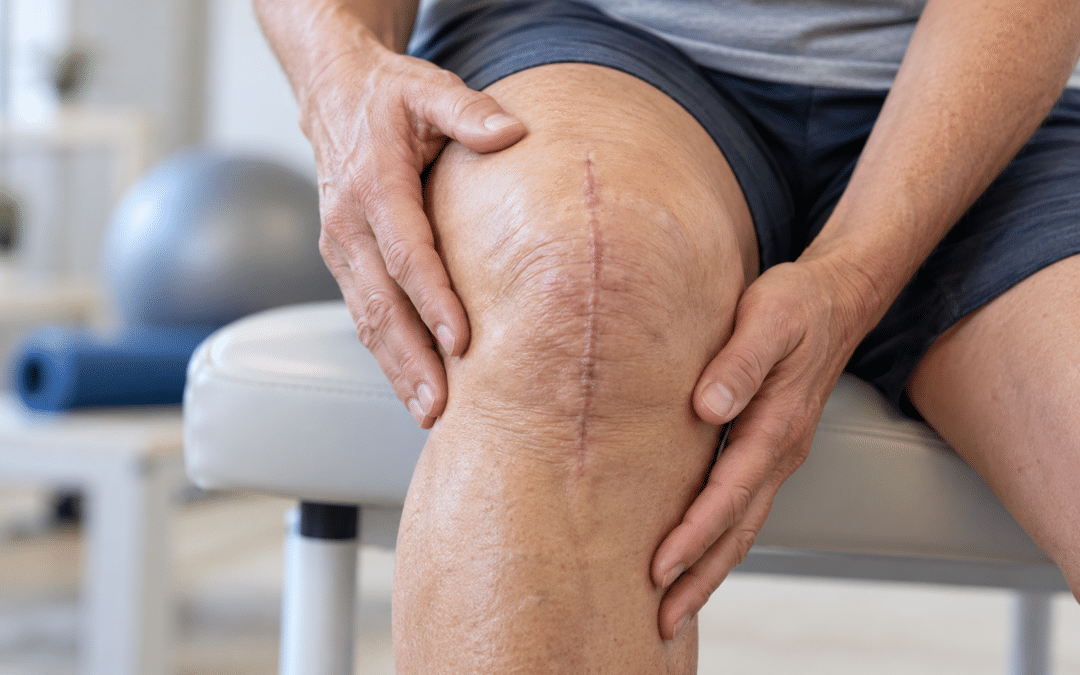
The visible scar along the skin is one type of scar tissue. It forms where the surgical incision heals and may initially feel raised, sensitive, tight, or numb.
Arthrofibrosis is different. It involves excessive fibrous tissue deeper within or around the knee joint that restricts motion.
Someone may have a thick or sensitive skin scar and still have excellent knee movement. Another person may have a relatively normal-looking incision but significant internal stiffness.
Physical therapy may address both issues, but the treatment approach is different.
Scar mobility techniques may sometimes help the superficial incision after it has fully healed and the surgical team has cleared it. Internal joint stiffness requires a broader assessment of range of motion, swelling, strength, and the overall recovery process.
What Physical Therapy Can Do
Physical therapy is one of the most important parts of knee replacement recovery because it helps restore motion while rebuilding the strength needed to use that motion effectively.
Early rehabilitation may focus on swelling management, gentle knee flexion and extension, quadriceps activation, walking, and safe movement around the home.
As recovery progresses, exercises become more functional. Sit-to-stand work, step exercises, resistance training, balance work, and longer periods of walking may be introduced as appropriate.
When stiffness is becoming a problem, the therapist can also monitor whether range of motion is still progressing or whether recovery appears to be plateauing.
That information can help determine when the orthopedic surgeon should be brought back into the conversation.
Physical therapy is not only about performing exercises. It is also an important monitoring process.
Why Forcing The Knee Harder Is Not Always Better
Patients who are worried about scar tissue sometimes assume they need to push through as much pain as possible.
That approach can backfire.
Aggressive stretching or exercise can increase inflammation and swelling. A more swollen knee may become even harder to move, which can create a frustrating cycle of forceful exercise followed by greater stiffness.
Effective rehabilitation requires enough stimulus to improve movement without repeatedly overwhelming the healing joint.
The right intensity will vary throughout recovery.
A patient may need more mobility work at one stage and more strength at another. Some days may call for reducing activity because the knee is unusually reactive.
Progress is usually built through consistency, not punishment.
What If Physical Therapy Is Not Improving The Stiffness?
If range of motion remains severely restricted despite appropriate rehabilitation, further evaluation may be necessary.
The orthopedic surgeon may need to determine whether excessive scar tissue is present and whether another cause of stiffness needs to be ruled out.
Postoperative stiffness can sometimes be related to infection, implant positioning, mechanical problems, persistent inflammation, or other conditions rather than arthrofibrosis alone.
This is why diagnosis matters.
Current research emphasizes distinguishing arthrofibrosis from other causes of limited motion before deciding on treatment.
Once the cause is better understood, the care team can determine whether continued rehabilitation is appropriate or whether another intervention should be considered.
Manipulation Under Anesthesia May Be Considered
For selected patients with significant early stiffness, an orthopedic surgeon may consider manipulation under anesthesia, commonly called MUA.
During this procedure, the patient is under anesthesia while the surgeon carefully moves the knee through a greater range of motion to help break up restrictive adhesions.
This is not something every patient with a stiff knee needs.
Timing, severity, range of motion, medical history, and the likely cause of stiffness all influence the decision. Current research generally supports earlier intervention when MUA is clearly indicated rather than allowing severe stiffness to remain indefinitely.
Rehabilitation remains important afterward because the newly gained motion needs to be maintained.
The procedure and physical therapy work together.
More Persistent Scar Tissue May Need Other Treatment
Some cases of arthrofibrosis do not respond adequately to rehabilitation or manipulation.
Depending on the severity and location of scar tissue, surgeons may consider arthroscopic removal of adhesions, open surgical release, or, in more complex situations, revision surgery.
These are considerably different from routine post-knee-replacement rehabilitation and are reserved for selected cases.
Current research recommends a stage-based approach because treatment needs differ between early stiffness and long-standing, severe arthrofibrosis.
For patients, the important message is that persistent loss of motion should be assessed early enough that there are still multiple treatment options.
Waiting indefinitely is not always the best strategy.
Recovery Still Requires Strength After Motion Improves
Regaining knee motion can feel like a major victory, but it is not the end of rehabilitation.
A knee that bends well but remains weak can still limit activity.
The quadriceps, hamstrings, calves, glutes, and surrounding muscles all help support the replaced knee. Strength is needed for stairs, longer walking distances, balance, and recreational activities.
Someone who hopes to return to hiking, cycling, golf, travel, or gym training will need even more capacity.
This is why the later stages of knee replacement physical therapy should begin to look increasingly like normal strength training.
Recovery gradually shifts from protecting the surgical knee toward preparing it for real life.
Walking Mechanics Should Also Recover
A stiff knee changes how people walk.
Patients may shorten the step on one side, avoid fully straightening the knee, move the hip differently, or place more weight through the opposite leg.
These compensations are understandable early in recovery, but they should gradually improve as motion and strength return.
Gait assessment can help identify lingering patterns.
A physical therapist may work on step length, knee extension, weight transfer, balance, and endurance so walking becomes more symmetrical and efficient.
This becomes especially important when a patient wants to return to longer walks, hiking, or other endurance activities.
Can Massage Break Up Knee Replacement Scar Tissue?
This is a common question.
Scar massage can sometimes help with sensitivity and mobility around a healed surgical incision, but external massage cannot simply break apart significant deep arthrofibrosis inside the knee joint.
Manual therapy may still be useful as part of rehabilitation. A physical therapist may work on surrounding soft tissues, kneecap mobility, swelling, and joint movement when appropriate.
However, patients should be cautious about treatments that promise to aggressively "break up" deep scar tissue from the outside.
Severe internal restriction needs proper assessment rather than increasingly forceful massage.
How Long Can Knee Replacement Stiffness Last?
Recovery timelines vary considerably.
Some patients regain functional motion relatively quickly, while others progress more gradually over several months.
Swelling can also continue for a surprisingly long time after major joint surgery, which means the knee may still feel different even as function improves.
The key question is whether progress is continuing.
If bending, straightening, walking, and strength are gradually improving, the knee may simply need more time.
If movement has stopped improving for an extended period or is becoming more restricted, the situation deserves reassessment.
Progress matters more than comparing your knee with someone else’s recovery calendar.
When To Contact Your Surgical Team
Routine stiffness is expected, but certain symptoms should be discussed with the surgical team.
Patients should seek medical guidance if the knee is becoming increasingly difficult to move rather than gradually improving, particularly when progress has clearly stalled.
Other concerning symptoms include:
- Increasing redness, warmth, drainage, or fever
- Sudden or significant worsening of swelling or pain
- Calf swelling or pain
- A new injury or sudden loss of function
- Persistent inability to bend or straighten the knee despite rehabilitation
These symptoms do not automatically mean arthrofibrosis, but they should not be ignored.
Scar Tissue After Knee Replacement Care At Avid
At Avid Sports Medicine in San Francisco, rehabilitation after knee replacement focuses on restoring movement while rebuilding the strength, balance, and walking ability required for daily life.
For patients dealing with stiffness, physical therapy can help assess how the knee is progressing and whether limited movement appears related to swelling, weakness, soft-tissue restriction, movement compensation, or another issue that requires communication with the orthopedic surgeon.
Treatment may include individualized mobility work, progressive strengthening, gait retraining, balance exercises, manual therapy when appropriate, and movement assessment. As recovery progresses, performance-based strength training can help patients move beyond basic rehabilitation and return to activities such as hiking, cycling, gym training, travel, or other recreational goals.
If your knee still feels unusually stiff after replacement or your range of motion has stopped improving, schedule an appointment with Avid Sports Medicine. A focused physical therapy assessment can help identify what is limiting your movement and build a recovery plan aimed at restoring mobility, strength, and confidence.
FAQ: Scar Tissue After Knee Replacement
Is Scar Tissue Normal After Knee Replacement?
Yes. Scar tissue formation is a normal part of surgical healing. It becomes problematic when excessive internal scar tissue restricts knee motion and function.
What Is Arthrofibrosis After Knee Replacement?
Arthrofibrosis is excessive fibrous scar tissue formation within and around the knee joint that can cause persistent stiffness, pain, and reduced range of motion.
How Do I Know If I Have Too Much Scar Tissue?
Persistent difficulty bending or straightening the knee, particularly when range of motion has stopped improving despite rehabilitation, may require evaluation for arthrofibrosis or another cause of postoperative stiffness.
Can Physical Therapy Help Scar Tissue After Knee Replacement?
Physical therapy can help restore range of motion, manage swelling, rebuild strength, improve walking, and monitor recovery. Severe arthrofibrosis may require additional treatment from the orthopedic surgeon.
Can Massage Break Up Scar Tissue After Knee Replacement?
Scar massage may help a healed surgical incision and surrounding superficial tissues, but it cannot simply remove significant internal arthrofibrosis.
What Happens If Knee Replacement Scar Tissue Gets Too Thick?
Excessive scar tissue can restrict knee bending and straightening, affecting walking, stairs, sitting, and other daily activities. More severe cases may require procedures such as manipulation under anesthesia or surgical removal of adhesions.
How Long Should Knee Stiffness Last After Replacement?
Some stiffness can persist for weeks or months, particularly while swelling remains. The overall trend should generally be toward improved motion and function.
When Is Manipulation Under Anesthesia Used?
Manipulation under anesthesia may be considered by an orthopedic surgeon when significant stiffness persists after knee replacement despite appropriate rehabilitation. Timing and individual circumstances influence the decision.
Can Scar Tissue Return After Treatment?
Arthrofibrosis can sometimes recur, which is why rehabilitation and maintenance of motion are important after procedures used to improve stiffness.
When Should I Get My Stiff Knee Evaluated?
Consider evaluation when range of motion has clearly stopped progressing, stiffness is worsening, or difficulty bending or straightening is significantly affecting normal activities.