
Key Takeaways
- Shockwave therapy benefits can include pain reduction, improved function, minimal interruption to daily activities, and a noninvasive treatment approach.
- Evidence is stronger for some conditions than others, making accurate diagnosis and patient selection important.
- Shockwave therapy often works best as an addition to physical therapy and progressive strengthening rather than as a replacement for rehabilitation.
- Avid Sports Medicine combines shockwave therapy with movement assessment, physical therapy, strength programming, and other non-surgical treatments when appropriate.
Some injuries are frustrating because they are not severe enough to stop everyday life completely, yet they never seem to disappear.
A heel hurts every morning but loosens once you start walking. An Achilles tendon feels manageable until you increase your running mileage. An elbow becomes painful every time you return to tennis or pickleball. A shoulder improves with rest, but the discomfort comes back as soon as you start lifting again.
These are often the kinds of situations in which people begin exploring shockwave therapy.
Shockwave therapy is a noninvasive treatment that uses controlled acoustic energy to stimulate targeted tissue. In sports medicine, it is commonly considered for persistent tendon and soft-tissue problems, particularly when symptoms have not improved enough with basic rest, exercise modification, or rehabilitation alone.
Benefit 1: Shockwave Therapy Is Noninvasive
One of the biggest reasons patients are interested in shockwave therapy is that it does not require surgery.
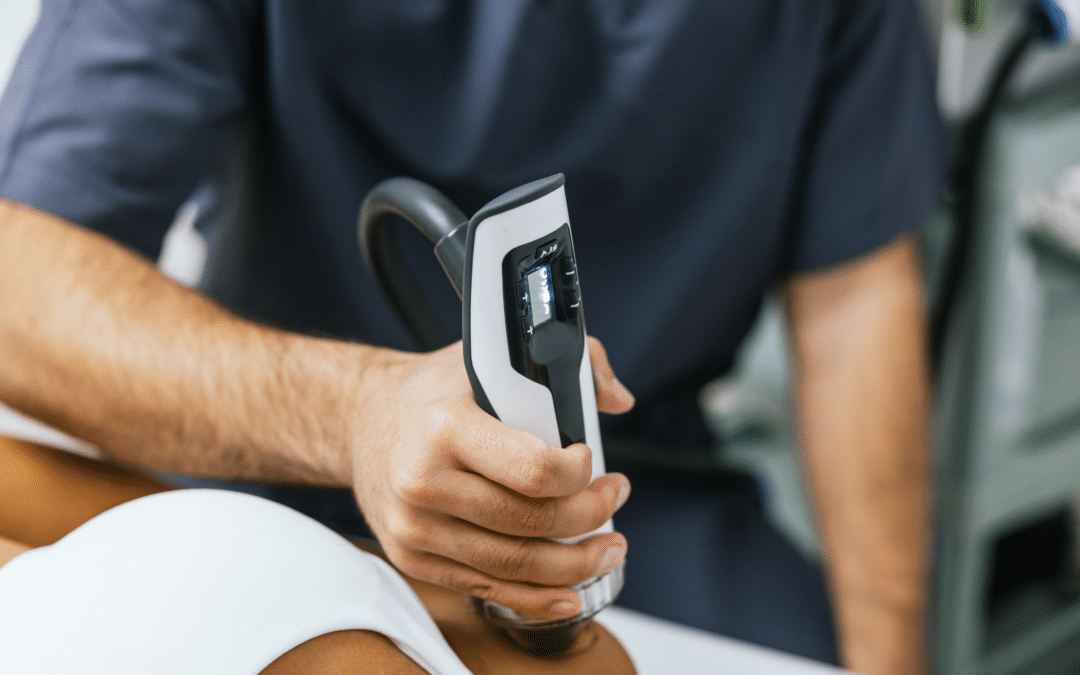
There is no incision and no tissue needs to be surgically repaired during the procedure. Instead, a clinician places an applicator against the skin and delivers acoustic energy into the targeted area. Treatment is generally performed in an outpatient setting, allowing patients to leave the clinic after the session rather than dealing with a surgical recovery period.
This makes shockwave particularly appealing for people who are still able to stay active but have reached a frustrating plateau with a chronic tendon or soft-tissue problem.
A noninvasive treatment does not mean that shockwave is automatically appropriate for every injury, but it does provide another option between basic conservative care and more invasive procedures.
For many active adults and athletes, having that middle ground can be valuable.
Benefit 2: It May Help With Persistent Tendon Pain
Tendons are among the tissues most commonly associated with shockwave therapy.
Tendon problems can become stubborn because tendons adapt relatively slowly. A painful tendon may improve when activity decreases, yet flare again as soon as running, jumping, lifting, throwing, or court sports return.
This cycle can continue for months.
Shockwave therapy is often considered when a tendon has remained symptomatic despite a reasonable period of conservative care. Research has investigated shockwave for conditions such as Achilles tendinopathy, tennis elbow, rotator cuff-related tendon problems, patellar tendinopathy, and other chronic tendon conditions.
Evidence varies between these conditions, so shockwave should not be treated as a universal tendon treatment. However, current research supports meaningful benefits for several musculoskeletal conditions, while continuing to investigate which patients and treatment protocols respond best.
The practical benefit is that shockwave can offer another treatment option when rehabilitation is progressing slowly and the tendon remains painful.
Benefit 3: It Can Help Reduce Pain
Pain relief is one of the most commonly reported reasons patients seek shockwave therapy.
The acoustic energy delivered during treatment is thought to influence pain signaling and tissue response. Rather than functioning like a numbing injection, shockwave appears to affect the way the treated area responds over time.
This distinction is important.
The goal is not necessarily to walk out of the first session completely pain-free. Some patients experience soreness immediately after treatment, and improvement may become more noticeable over a series of sessions or during the weeks that follow.
When treatment is effective, the reduction in pain can make normal movement easier and allow patients to participate more confidently in rehabilitation.
That can create an important opportunity. When pain is no longer dominating every exercise or activity, strength and movement can progress more effectively.
Benefit 4: Better Function Can Matter More Than Pain Scores
Pain is important, but function is often the outcome patients care about most.
- A runner wants to run.
- A tennis player wants to serve without elbow pain.
- Someone with plantar fascia pain wants to get out of bed and walk normally.
- A person with shoulder pain wants to reach overhead, sleep comfortably, and return to the gym.
One of the potential benefits of shockwave therapy is improvement in function alongside pain reduction. Research on various musculoskeletal conditions has evaluated not only pain scores but also measures of movement, activity, strength, and quality of life.
This is how treatment should be judged in the real world.
If pain improves slightly but the patient still cannot return to normal activity, the treatment has only solved part of the problem. A more meaningful recovery includes stronger movement, increased activity tolerance, and greater confidence using the affected area.
Benefit 5: It May Help When Rest Has Reached Its Limit
Rest is useful during many injuries, particularly in the early stages.
But persistent tendon problems often expose the limitations of rest-only treatment.
Consider a runner with Achilles pain. Reducing mileage may calm the tendon, and after several weeks the runner may feel much better. The problem appears solved until running volume increases again.
If symptoms immediately return, the tendon may not have regained enough capacity for the demands being placed on it.
The same pattern can occur with plantar fascia pain, tennis elbow, or shoulder tendon irritation.
Shockwave may be considered in these situations because it can be combined with progressive rehabilitation rather than requiring a patient to simply keep waiting.
The goal is to move beyond the cycle of pain, rest, temporary relief, and reinjury.
Benefit 6: Shockwave Can Be Combined With Physical Therapy
Shockwave therapy does not have to compete with physical therapy.
In many cases, the two make more sense together.
Shockwave may help influence pain and tissue response, while physical therapy addresses strength, mobility, movement control, and load tolerance.
Consider someone receiving shockwave therapy for Achilles tendinopathy. The treatment may target the painful tendon, but the runner may still need stronger calves, better ankle control, changes in training volume, and a gradual return-to-running plan.
Similarly, someone receiving shockwave for plantar fascia pain may need foot and calf strengthening. An athlete with elbow pain may need progressive forearm and shoulder training.
This combination is one of the most practical shockwave therapy benefits because treatment does not have to interrupt rehabilitation. Instead, it can support a larger recovery strategy.
Benefit 7: There Is Usually Little Disruption To Daily Life
One reason people delay treatment for persistent injuries is concern about downtime.
They may be working full time, caring for family, training for an event, or simply unwilling to go through a lengthy recovery unless absolutely necessary.
Shockwave therapy usually requires much less interruption than surgery.
Treatment sessions are relatively brief, and most patients can continue with many normal daily activities afterward. Depending on the condition and treatment intensity, a clinician may recommend temporarily modifying certain exercises or high-load activities.
That does not mean patients should immediately test the painful area with maximum effort after every session.
It simply means shockwave can often be incorporated into an existing rehabilitation schedule without completely putting life on hold.
Benefit 8: It May Help Plantar Fascia Pain
Plantar fasciitis is one of the conditions for which shockwave therapy has received considerable attention.
Persistent plantar fascia pain can be particularly frustrating because the foot is loaded throughout the day. Even if someone stops running, they still need to stand and walk, which makes complete rest unrealistic.
Symptoms often include heel pain during the first few steps in the morning, discomfort after sitting, or pain that becomes more noticeable after long periods of standing or exercise.
Current reviews identify chronic plantar fasciitis as one of the conditions with stronger evidence supporting shockwave therapy.
For patients who have already tried footwear changes, stretching, activity modification, and strengthening without enough improvement, shockwave may provide another non-surgical option.
However, treatment should still address the strength and movement demands of the foot and calf. The plantar fascia does not function in isolation.
Benefit 9: It Can Be Useful For Some Shoulder Problems
Shockwave therapy is also used for certain shoulder conditions, particularly calcific rotator cuff tendinopathy.
In this condition, calcium deposits develop within a rotator cuff tendon and can contribute to pain and limited shoulder movement.
Research has shown relatively strong support for shockwave therapy in calcific rotator cuff tendinopathy compared with several other musculoskeletal applications.
The benefit again extends beyond simply reducing discomfort. Improved pain can make it easier for patients to restore shoulder movement and participate in strengthening exercises.
The shoulder still needs rehabilitation, especially if pain has caused weakness or altered movement for a long period.
Shockwave treatment and shoulder strengthening therefore often work toward the same broader goal.
Benefit 10: It Can Support A More Active Recovery
Many patients assume injury recovery requires choosing between two extremes: keep exercising normally despite pain or stop activity completely.
Sports medicine often provides a third option.
Activity can be adjusted while the injured area gradually becomes stronger.
Shockwave therapy can fit well within this type of active recovery because it can be used alongside rehabilitation rather than requiring the patient to remain inactive for extended periods.
A runner may temporarily reduce hills and speed work while continuing appropriate conditioning.
A tennis player may modify playing volume while strengthening the forearm and shoulder.
Someone with plantar fascia pain may reduce high-impact activity while improving calf and foot capacity.
The treatment plan becomes less about avoiding movement and more about finding the right amount of movement.
What Shockwave Therapy Cannot Do
Understanding the benefits of shockwave therapy also means understanding its limitations.
Shockwave is not a cure for every type of musculoskeletal pain. It cannot repair a complete tendon rupture, correct a major structural injury, or replace surgery when surgery is clearly required.
Research also does not show equally strong benefits for every condition. Some conditions have encouraging evidence, while others have inconsistent results.
That is why the treatment should follow an accurate diagnosis.
Choosing shockwave simply because something hurts can lead to disappointing results. Choosing it because the tissue, condition, stage of recovery, and patient goals make sense gives treatment a much clearer purpose.
Focused And Radial Shockwave Are Not Identical
Patients may encounter the terms focused shockwave therapy and radial shockwave therapy.
These treatments deliver mechanical energy differently. Focused shockwave can concentrate energy into a more defined area and reach deeper tissues, while radial treatment spreads energy more broadly from the applicator.
Recent systematic reviews have not established one method as universally superior across musculoskeletal conditions. The most appropriate approach depends on the condition, treatment target, equipment, and clinician’s judgment.
For patients, the important question is therefore not simply which machine is being used.
It is whether the treatment is appropriate for the problem being treated.
How Many Sessions Does Shockwave Therapy Take?
There is no single schedule that applies to every patient.
Treatment protocols vary depending on the condition, tissue, severity of symptoms, type of shockwave device, and individual response. Many treatment plans involve a series of sessions rather than one treatment.
Progress should be judged over time.
A patient may notice reduced morning stiffness first. Another may realize they can walk farther before symptoms begin. A runner may gradually tolerate more mileage. Someone with elbow pain may notice that gripping or lifting becomes easier.
These functional changes can be more useful than waiting for one dramatic moment when all pain disappears.
What Does Shockwave Therapy Feel Like?
Shockwave therapy is delivered through a handheld applicator placed against the treatment area.
Patients typically feel repeated tapping or pulsing sensations. Areas that are already sensitive may feel uncomfortable during treatment, although the intensity can usually be adjusted.
Temporary soreness afterward can occur.
The experience should be discussed with the provider because treatment intensity should reflect both the condition and the patient’s tolerance.
The goal is not to make treatment as painful as possible. Higher intensity does not automatically mean better results.
Who Might Benefit Most From Shockwave Therapy?
Shockwave is often considered when a condition has persisted longer than expected and conservative treatment has not produced enough improvement.
It may be particularly relevant for some people with chronic tendon or fascia-related conditions who are trying to avoid more invasive treatment.
However, the decision should consider the diagnosis, duration of symptoms, previous treatment, medical history, and activity goals.
A runner trying to return to marathon training may have different requirements from someone whose main goal is comfortable everyday walking.
A good treatment plan accounts for that difference.
Why Diagnosis Matters Before Shockwave
Persistent pain can have more than one possible cause.
Heel pain may come from the plantar fascia, Achilles tendon, nerve irritation, or another structure. Shoulder pain may involve the rotator cuff, joint, bursa, or referred pain from elsewhere. Elbow pain may be tendon-related, but not every painful elbow is tennis elbow.
Using shockwave without understanding the diagnosis risks treating the wrong tissue.
This is why a sports medicine evaluation can be valuable before beginning treatment.
The clinician can assess symptoms, strength, mobility, movement, and medical history before determining whether shockwave is appropriate or whether another treatment should come first.
Shockwave Therapy Benefits At Avid Sports Medicine
At Avid Sports Medicine in San Francisco, shockwave therapy is incorporated into a broader approach to sports injuries, tendon problems, and persistent musculoskeletal pain.
The goal is not simply to perform a procedure and send patients back to the same activity pattern that caused symptoms in the first place. Treatment can be combined with individualized physical therapy, gait and movement analysis, strength programming, and return-to-sport or return-to-running planning when appropriate.
If tendon, heel, shoulder, or other musculoskeletal pain keeps returning despite rest and rehabilitation, schedule an appointment with Avid Sports Medicine. The team can determine whether shockwave therapy is appropriate and build a treatment plan focused on reducing pain, rebuilding strength, and helping you return to the activities that matter to you.
FAQ: Shockwave Therapy Benefits
What Are The Main Shockwave Therapy Benefits?
Potential benefits include reduced pain, improved function, a noninvasive treatment approach, limited downtime, and the ability to combine treatment with physical therapy and strength rehabilitation.
How Quickly Does Shockwave Therapy Work?
Results vary. Some patients notice changes after several treatments, while others improve gradually over the following weeks as rehabilitation continues.
What Conditions Benefit Most From Shockwave Therapy?
Evidence is strongest for certain conditions including chronic plantar fasciitis, calcific rotator cuff tendinopathy, greater trochanteric pain syndrome, and some Achilles tendon problems. Treatment should always be matched to the diagnosis.
Does Shockwave Therapy Heal Tendons?
Shockwave is intended to stimulate biological responses within treated tissue and may help some tendon conditions. It should not be viewed as an instant way to rebuild damaged tissue.
Is Shockwave Therapy Better Than Physical Therapy?
They serve different purposes and can often be used together. Physical therapy rebuilds strength and movement capacity, while shockwave may help with pain and tissue response in selected conditions.
Is Shockwave Therapy Painful?
Treatment can feel uncomfortable, particularly over a sensitive tendon or fascia, but intensity can usually be adjusted. Temporary soreness after treatment may occur.
Does Shockwave Therapy Require Downtime?
Most patients do not require extensive downtime, although certain activities may need temporary modification depending on the injury and treatment plan.
Is Shockwave Therapy A Surgery?
No. Shockwave therapy is noninvasive and does not require an incision.
Can Runners Benefit From Shockwave Therapy?
Some runners with persistent Achilles, plantar fascia, or other appropriate tendon conditions may benefit when shockwave is combined with strength and return-to-running rehabilitation.
How Do I Know If Shockwave Therapy Is Right For Me?
A sports medicine evaluation can determine the likely source of pain, review what treatments have already been tried, and decide whether shockwave fits the condition and your recovery goals.